Jesus' Birth in Bethlehem (Luke 2:1-7)
Copy Right is Dr. Ralph F. Wilson
Lessons in e-book format
Sign up for the free  Ephesians Bible Study
Text
Luke 2:1-7
[2:1] In those days Caesar Augustus issued a decree that a census should be taken of the entire Roman world. [2] (This was the first census that took place while Quirinius was governor of Syria.) [3] And everyone went to his own town to register.
[4] So Joseph also went up from the town of Nazareth in Galilee to Judea, to Bethlehem the town of David, because he belonged to the house and line of David. [5] He went there to register with Mary, who was pledged to be married to him and was expecting a child. [6] While they were there, the time came for the baby to be born, [7] and she gave birth to her firstborn, a son. She wrapped him in cloths and placed him in a manger, because there was no room for them in the inn.
Exposition
How cute to see some girl's doll, recruited at the last minute and wrapped tightly in a blanket, lying amidst the straw of an X-ended manger that dwells the remainder of the year in the church attic. Jessica stands in for Mary, while Robert, the tallest boy in Sunday school this year, makes a perfect Joseph -- once they've applied his fake beard.
Now don't get me wrong. I'm not at all against nativity scenes. But we've seen so many, year after year, that it's hard for us to read Scripture and see with fresh eyes what it actually says to us. Open your Bible to Luke 2:1-7 and read it. These verses make four important points about the birth of Jesus:
- Jesus is born in history.
- Jesus is born in David's birthplace.
- Jesus' birth is attended by hardship.
- Jesus is born in humble circumstances.
Jesus Is Born in History (2:1-2)
"In those days Caesar Augustus issued a decree that a census should be taken of the entire Roman world. (This was the first census that took place while Quirinius was governor of Syria.)" (2:1-2)
Jesus has an historical context; he's neither a myth nor a legend.
A myth is "a person or thing having only an imaginary or unverifiable existence."[1] But Jesus was born in history. A legend is "a story coming down from the past; especially one popularly regarded as historical although not verifiable."[2] 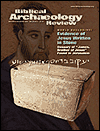 But Jesus is both historical and verifiable. He is mentioned not only in the New Testament, but by contemporaries and early documents such as Josephus, Pliny, Tacitus, Suetonius, Bar-Serapion, Thallus, Lucian, Josephus, and the Talmud.[3] The November-December 2002 issue of Biblical Archaeology Review announced the discovery of a First Century ossuary (bone burial box) that likely bears the name of Jesus' brother James, as well as Jesus' own name.
Jesus is a person in history. Here are those who were in power when Jesus was born:
"Caesar Augustus" was the emperor Octavian, founder of the Roman Empire, who reigned from AD 27 until AD 14, when he was succeeded by Tiberius Caesar. Herod the Great (Matthew 2:1) was called "king of the Jews, and who ruled Judea from 40 to 4 BC. His reputation for paranoia and ruthlessness was well deserved, having executed three of his own sons, and slaughtered all the baby boys in Bethlehem (Matthew 2:16).
The third ruler is Quirinius. He was a military leader and Roman consul in central Asia Minor, and later Imperial Legate of Syria-Cilicia (AD 6 to 9), where Josephus notes that he conducted a census.[4] The census referred to in Luke 2 isn't recorded historically, but probably took place under a kind of extraordinary command authority he possessed during his military maneuvers in Cilicia or possibly during a brief earlier stint as governor in Syria.[5]
Early heresies such as Docetism and modern heresies such as Christian Science strip Jesus of his place in history and turn him into some kind of "Christ figure" or metaphysical guru. But Scripture persistently places him within history as a man who lived and died and rose again in real time, a man who permanently altered the history into which he was born.
Jesus Is Born in David's Birthplace (2:3-4)
"And everyone went to his own town to register. So Joseph also went up from the town of Nazareth in Galilee to Judea, to Bethlehem the town of David, because he belonged to the house and line of David." (2:3-4)
The second point of our passage is that Jesus was born in the birthplace of David, Israel's greatest King. Nearly 1000 years before Jesus' birth, God had promised to David through the Prophet Samuel, "Your house and your kingdom will endure forever before me; your throne will be established forever" (2 Samuel 7:16). Micah had prophesied 730 years previously:
"But you, Bethlehem Ephrathah,
though you are small among the clans of Judah,
out of you will come for me
one who will be ruler over Israel,
whose origins are from of old,
from ancient times." (Micah 5:2)
The Jews eagerly expected David's successor and called this hoped-for Messiah the "Son of David." Jesus is the Son of David, this promised King. It is no accident that Joseph was "of the house and lineage of David" (Luke 2:4, KJV) and that Jesus was born in Bethlehem.
Jesus' Birth is Attended by Hardship (2:5-6)
"He went there to register with Mary, who was pledged to be married to him and was expecting a child. While they were there, the time came for the baby to be born." (2:5-6)
But Mary and Joseph lived in Nazareth and God needed them in Bethlehem for this birth. "It just so happened..." that the Romans ordered a tax census and Joseph was required to return to his ancestral town, Bethlehem, for enrollment.[6] This meant hardship for the Holy Family. The most glorious event in history is about to unfold, but for Joseph and Mary it is drudgery and hardship -- a real pain.
- Mary and Joseph live in Nazareth, four days journey north of Bethlehem.
- Mary is pregnant. A journey late in pregnancy is arduous for her. But if she stays in Nazareth she has to face scandal alone. Luke puts it delicately: "... Mary, who was pledged to be married to him and was expecting a child" (2:5).
- Compounding that, it was probably winter, if second century church tradition is to be taken seriously.[7]
An arduous journey in winter, a pregnant teenage mom. Who says that following God's plan is easy? Just because we face hardships and obstacles is no indication that God is absent, that we've missed his will. Sure we face trouble. But then, we face even more trouble if we DON'T follow Jesus. Jesus faced obstacles, but told his disciples, "In this world you will have trouble. But take heart! I have overcome the world" (John 16:33).
Jesus Is Born in Humble Circumstances (2:7)
"... And she gave birth to her firstborn, a son. She wrapped him in cloths and placed him in a manger, because there was no room for them in the inn." (2:7)
The manger astounds me. Jesus wasn't born in a snug home -- "there was no room for them in the inn." We've romanticized the birth and swept up after the animals. But the evidence is clear: the holy Son of God was born in a stable or cave where animals were kept, and his first crib was a common cattle trough. Why? I wonder. I don't think this was by accident or the Father's lack of provision for his Son. There's a message here. Though Jesus was by very nature God (Philippians 2:6), he didn't grasp at his prerogatives or flaunt his rights. Instead, he "made himself nothing (Greek kenoo), taking the very nature of a servant, being made in human likeness...." (Philippians 2:7). The Greek verb kenoo means "make empty"[8]. Jesus literally "emptied himself" of all the privileges to which he was heir. He didn't just take a low place, he took the lowest place. His commission was "to preach good news to the poor" (Luke 4:18; quoting Isaiah 61:1), so he was born among the poorest of the poor. His disciples argued about who would be greatest in the Kingdom, but Jesus stopped them short: "For even the Son of Man did not come to be served, but to serve, and to give his life as a ransom for many" (Mark 10:45). The manger represents serving.
The message for us is clear: Jesus' disciples are not to seek glory but servanthood. Serving when it is convenient and when it is not. Serving when no one understands or appreciates what we do. Christmas teaches us servanthood, God's serving -- and then ours.
Prayer
Father, sometimes we're so fussy, so picky about what we will and will not do. Please forgive us and make us pliable in your hands. Make us willing to be your servants, wherever you send us out of our comfort zones, and whatever it takes. In Jesus' name, we pray. Amen.
Key Verse
"And she gave birth to her firstborn, a son. She wrapped him in cloths and placed him in a manger, because there was no room for them in the inn" (Luke 2:7)
Questions
 |
- Why does Luke name the Roman rulers in 2:1-2? What point is he making?
- What is the significance of Joseph being a descendant of David? (2:4) What is the significance of Bethlehem in Messianic prophecy (Micah 5:2)?
- What is the scandal in verse 5? What hardship is Mary experiencing? What about Joseph?
- Why do you think the journey to Bethlehem difficult for Mary? Is pleasure an indication that we are in God's will or not? Any examples from your life?
- Extra Credit: Argue for or against this proposition: "Being a consistent Christian causes more hardships than just going with the flow."
- To what do you attribute Messiah's birth in a stable -- poor planning? (2:7) What message does the manger convey to modern-day disciples?
- If our culture is enamoured with bigness and success, and humility runs across the grain, what appeal can the humble Jesus have to people today?
- Extra Credit: How far do you think Jesus "emptied himself" by being born a human? What aspects of his divinity did he retain during his time in human flesh? What aspects did he lay aside?
References
See Common Abbreviation,
- Merriam-Webster, p. 770.
- Merriam-Webster, pp. 664-665.
- Josh McDowell, Evidence That Demands a Verdict (Campus Crusade for Christ, 1972), documents all these references and more in Chapter 5: "Jesus--a Man of History," pp. 83-89.
- Josephus, Antiquities 18.1-3,26, referred to in Acts 5:37.
- The controversy surrounding Quirinius and this census are discussed fully in C.L. Blomberg, "Quirinius," ISBE 3:12-13; and Marshall, pp. 99-105.
- Usually Romans conducted a census where residents lived, but there is a precedent for the procedure we see in Luke 2:3-5. A decree of C. Vibius Maximus, dated in AD 104, required absentees to return to their home towns for a census in Egypt (P. Lond. 904, 20f; cited in J.M. Creed, St. Luke, London: Macmillan, 1930).
- The date of December 25 goes back to Hippolytus (AD 165-235), and Chrysostom (AD 345-407), who stated in 386 that December 25 is the correct day. Brief discussion in ISBE 1:688.


 11:08 PM
 Unknown


